| 作者 |
 [分享]China's Economy: Something Is Not Right in Beijing (zt) [分享]China's Economy: Something Is Not Right in Beijing (zt) |

 |
楚留情

头衔: 海归少校
声望: 学员
性别:  年龄: 35 年龄: 35
加入时间: 2005/04/30
文章: 118
海归分: 17639
|
|
|
作者:楚留情 在 海归商务 发贴, 来自【海归网】 http://www.haiguinet.com
China's Economy: Something Is Not Right in Beijing (ZT)
by Derek Scissors, Ph.D.
作者认为,中国公布的数据很多地方自相矛盾。其一是几个月来2千多万人口失业,但失业率维持在5%的低水准。其二是刺激政策规模相当GDP的13%,让去年GDP增长8.7%,消费增长16%,但却无通膨问题,物价反而下跌0.7%,出现与日本类似的通缩。其三,去年房产销量推估的价格上涨率,远远超过了中国官方公布的物价上涨率3倍。
此外,民间消费的数据也有问题,因为中国将零售销售与国营企业相互间的买卖混为一谈。这导致了2001年至2009年间的零售销售与个人储蓄的增长幅度远远大于家计收入的增幅。换言之,这9年来中国家庭的消费与储蓄都超过了收入,这分明是一组离谱的数据。
其他GDP的组成因素,如固定投资、贸易顺差、政府预算的计算也都有被夸大的问题,如此便将GDP重复计算,也导致了实质GDP的增长幅度低于各个组成因素的错谬了。每当被问到数据为何兜不拢时,中共中央统计局(SSB)往往辩称,零售销售与固定投资都不是衡量消费与投资的正确指标。如此一再的错谬,导致了中国的经济增长速度,远远超过了其他的开发中国家。
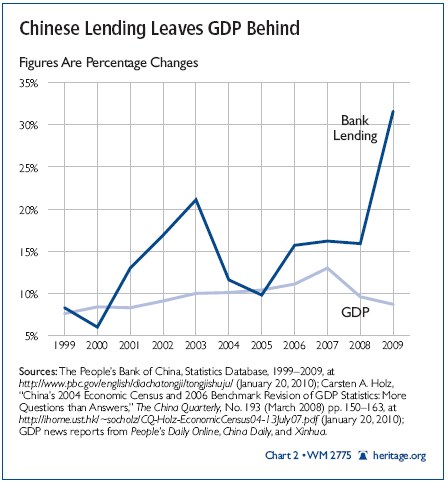
作者还质疑,如果中国国家统计局(SSB)的数据是正确的,那么中国的经济政策便让人无法理解了。中国去年四兆人民币刺激经济,国营银行新增信贷1.4兆,相当于30%的GDP,但近期中国官员表示,今年仍将维持去年的宽松政策。他说,1999年中国信贷只增长6%,GDP增长7.6%,但2009年银行体系信贷增加了32%,GDP却只增长9.6%,信贷刺激的效果在递减,而且这种过度刺激的政策也有副作用,浮滥资金到处流窜,导致房地产飙涨、经济失衡。
2009年初,中国媒体报导2千万民工失业,当时半年内的GDP是6.5%,也就是说,GDP在7%以下,已被中国主政者视为灾难,必须祭出刺激经济的重要门槛,换个角度讲,经济增长的前7%对就业毫无帮助。
为了保证GDP达到8%以上,中国似乎不得不将刺激政策视为常态,但由于就业与信贷或刺激政策的关联度越来越低,中国就必须加大刺激的力度,这也说明中国的经济政策有问题。如果中国发布的经济数据正确的话,那么不久中国的经济将来到悬崖的边缘,GDP将增长10%,但对就业的创造效果有限,而资产泡沫的问题却一发不可收拾。
作者还提到,自2003年来,中国国务院便呼吁增加消费、减少投资,以平衡经济增长的组成,但这个失衡的现象却反而越趋严重,长此以往,投资占GDP的份额若迟迟无法剧降,或许只能重回计划经济的老路了。
关于信贷的问题,作者认为,2005年中国的信贷增幅不及GDP,2006年以后信贷与GDP同步增长,直到2009年才出现信贷增幅大大超越GDP的现象。在信贷暴增下,2009年中国房产销售增长的金额,将近占了90%的GDP增长金额,显然房市对中国的GDP贡献卓著。
然而,房地产价格有朝一日终将停止上涨,一旦反转下跌,企业与投资客将产生巨大亏损,股市也将间接受到冲击。根据经验法则,过度信贷之后,通常伴随着泡沫破灭,中国未来很可能重蹈日本与美国的泡沫覆辙。中国官方公布的经济数据,表面上似乎皆大欢喜,但却遮掩不了未来中国经济前景的坎坷与不平。
***********************
原文全文如下,自己看吧:
Consider two countries. The first country reported:
• Annual GDP growth of 9.6 percent, then 8.7 percent;
• Consumption expanding at better than a 16 percent inflation-adjusted rate over those two years; and
• Unemployment stable at a very low level.
The second country reported:
• Job losses of at least 20 million over just a few months;
• A stimulus equivalent to 13 percent of GDP, led by local governments despite severe local debt problems; and
• Deflation comparable to the worst of Japanese deflation.
Both of these countries, of course, are China in 2009.
Consider two more countries, where this time their identities are trickier to discern: The first country reported strong real GDP growth of 9.6 percent yet responded the following year by expanding lending in a state-directed banking system by a wild 32 percent. The second reported solid real GDP growth of 7.6 percent and responded the following year by expanding lending in a state-directed banking system by a subdued 6 percent.
The first country is China in 2008-2009; the second is China in 1999-2000.
China's State Statistical Bureau (SSB) claims that everything from GDP to consumption to employment is humming along. If its economic statistics are accurate, Chinese policy is then incomprehensible--even by the PRC's own standards of less than a decade ago. Because there are so many flaws in the numbers, it is certainly plausible that they have been falsified while Beijing's policy choices have been largely correct.
The other possibility, though, is that the economy really has been doing fairly well. In this case, however, hyper-stimulative policy is a travesty. The State Council has demanded frantic bank lending that has generated far too much liquidity, a stunning increase in commercial property sales, and an even more unbalanced economy. The American version of this policy ended badly and the Chinese version will as well, whatever official data say.
Is It Bad Data?
Much published Chinese data is unusable, unemployment being an obvious example. Because most of the workforce is excluded, China's official unemployment rate invariably stays under 5 percent. This is acknowledged even by government think tanks to understate urban unemployment by at least a factor of 2 and total unemployment by perhaps a factor of 3,[1] but it will remain the official word because in China, politics trump accuracy.
In prices, sales volume and sales value (volume multiplied by inflation) often clash sharply with announced inflation. Last year, the property price increase implied by official sales data was three times faster than official property inflation.[2] This has also been the case at various times in autos and other major consumer markets. The broadest definitions of prices are the consumer price index and the deflator used to turn the simple arithmetic change in GDP into official real GDP growth. It has become very difficult to find a consistent relationship between these two, suggesting that either official GDP or consumer inflation is inaccurate.
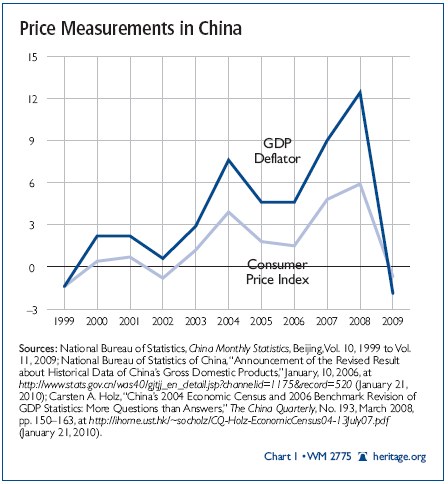
There is a theme to these results: severe problems measuring anything related to consumers. Chinese consumption is vital to global economic health, but the official indicator for consumption is fatally flawed. The indicator--retail sales--can as much as double true consumption growth by counting shipments to vendors that are never sold and purchases by state firms from other state firms, which are sometimes made to merely bulk up sales figures.[3]
This mis-measurement has outlandish results. From 2001 to 2009, both retail sales and personal savings rose far faster than household income. In other words, over a nine-year period, Chinese households appeared to be able to both spend much faster and save much faster than they earned, a nice trick. This is chiefly because retail sales do not measure genuine consumer spending.
It is also routinely the case that the components of GDP--retail sales, fixed investment, the trade surplus, and the government budget--add to more than GDP and that real growth of GDP is somehow far slower than real growth of all components. When pressed, the SSB argues retail sales and fixed investment are not the correct measures of consumption and investment. It then continues to publish only the incorrect measures.[4] Finally, Chinese data emerge far more quickly than for any developed economy.[5]
Or Is It Bad Policy?
So when the PRC says that 2009 real GDP grew 8.7 percent, real retail sales grew 16.9 percent, and consumer inflation was -0.7 percent, some of the results may be fraudulent. Indeed, it seems that even China's government might believe so.[6]
The PRC announced a growth rate of 9 percent for 2008, revised to 9.6 percent. Growth in the fourth quarter of 2008 dipped only slightly below 7 percent and stayed above 6 percent in the first quarter of 2009 before again spiking higher.
Beijing reacted with absolute panic. In addition to the touted 4 trillion yuan fiscal package, bank lending rose an astonishing 32 percent last year. State banks pushed out $1.4 trillion in new loans, the equivalent of nearly 30 percent of GDP. In recent weeks, government officials pledged to continue roughly the same fiscal and monetary policy.[7]
This is a very odd reaction. The central government chose an emergency response to an emergency that never materialized in official data. Further, it has committed to largely continuing that emergency response, even though official growth has averaged almost 10 percent over the previous six months.
It may be that hyper-stimulus has become the normal state of affairs. The willingness in the early part of this decade to genuinely target 8 percent GDP growth and accept 7 percent when necessary looks to have been replaced by a growth target closer to 10 percent, where 7 percent is considered a disaster.
.
Such a change would be driven by jobs. Early in 2009, Chinese media reported 20 million lost jobs among migrant workers alone, in addition to any job losses among resident urban workers and rural workers.[8] This occurred in the context of GDP growth of about 6.5 percent over a six-month period. If GDP growth dipping below 7 percent entails massive job losses, then the emergency response was justified.
Unfortunately, this would also mean China's economic strategy is failing. It is one thing for Chinese officials to suggest--as they have for over a decade--that 7 percent growth is needed to absorb new labor market entrants, though even this number seems strangely high. It is quite another for near-7 percent growth to be associated with potentially catastrophic job losses. At that point, the only conclusion is that China's growth model has become astonishingly bad for employment.
If so, that explains the trend toward hyper-stimulus. The job market has become less and less responsive to lending and other government policy, forcing the government to ramp up spending that much faster. The evidence for this is overwhelming. In 1999, fixed investment was equivalent to 26 percent of GDP. Just 10 years later, it was equivalent to a staggering 67 percent.
This cannot continue, either in terms of the basic figures or the economic reality behind them. If Chinese data are accurate, policy is therefore headed straight off a cliff--constantly pushing real GDP growth near 10 percent but in an increasingly futile and clearly unsustainable effort to create jobs.
The Inevitable Bust
There is a debate over whether major sectors of the economy are expanding unsustainably, a bubble with Chinese characteristics. One point to note is that the data may be faulty. A second is that bubbles in a mixed economy like the PRC's are not the same as bubbles in a market economy. When China's bubble bursts, it will not look like the financial crisis in the U.S.
The last point is that the Chinese economy does have fundamental weaknesses. The State Council began calling for rebalanced consumption and investment in 2003, yet the imbalance is much worse. Investment is far beyond any precedent for a market economy--either the investment share of GDP must eventually plunge or China will revert to a planned system.
In the near term, there are problems in banking and real estate. In 2005, bank lending was actually slower than real GDP. Since then, GDP has stayed fast but has required more and more lending to do so, typical for the latter half of a boom and always a severe strain on any banking system.
Real estate may be worse. The increment to commercial property sales in 2009 was equivalent to almost 90 percent of the increment to GDP. Without property, the Chinese economy would be in the terrible shape the government feared. In this light, the outpouring of liquidity is understandable, but it is still dangerous. The surge in property prices must eventually halt. This will expose investors, from individuals to the biggest state banks, to heavy losses that will then be compounded by ensuing stock market weakness.
It is certainly true that China's experience will not be the same as Japan's 20 years ago or America's last year, especially since official data are altered for political reasons. Nonetheless, a bust always follows a liquidity-driven boom. The SSB's reports will remain happy, but the Chinese economy is headed for a rough patch, this time domestic in origin.
作者:楚留情 在 海归商务 发贴, 来自【海归网】 http://www.haiguinet.com
|
|
|
| 返回顶端 |
|
 |
|
-
 [分享]China's Economy: Something Is Not Right in Beijing (zt) -- 楚留情 - (11141 Byte) 2010-1-27 周三, 13:43 (2552 reads) [分享]China's Economy: Something Is Not Right in Beijing (zt) -- 楚留情 - (11141 Byte) 2010-1-27 周三, 13:43 (2552 reads)
|
|
|
|
您不能在本论坛发表新主题, 不能回复主题, 不能编辑自己的文章, 不能删除自己的文章, 不能发表投票, 您 不可以 发表活动帖子在本论坛, 不能添加附件不能下载文件, |
|
|


